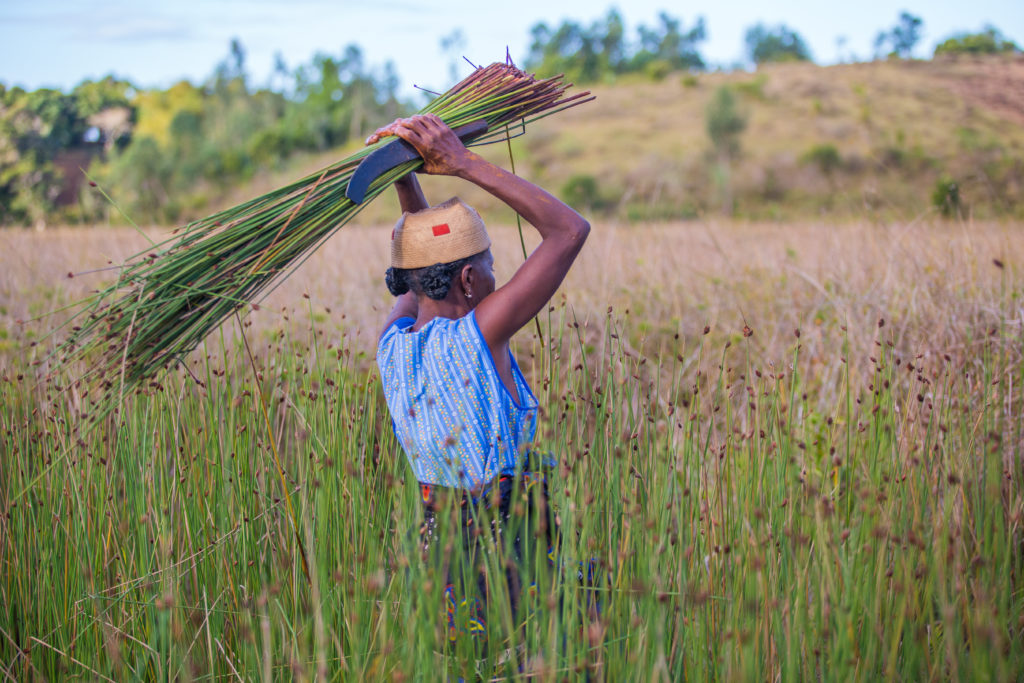
Vivienne Rakotoarisoa harvests a reed known locally as Rambo (scientific name: Lepironia articulate) on her small plot of land in Mangatsiotra village in Madagascar’s coastal Vatovavy Fitovinany region, which she will later craft into baskets and mats to sell at a nearby market. Having previously relied heavily on rice farming - where harvests have been hampered by unpredictable rainfall in recent years - this climate resilient crop is able to withstand periods of erratic rainfall, providing Vivienne and her family a more stable source of income in the face of a changing climate. Vivenne is one of 3000 community members who were provided with ‘rambo’ seeds and trained in how to cultivate, care for and maximise yield as a springboard towards diversifying their livelihoods. This exciting initiative is part of a five year project launched in 2015 by UN Environment and its partners, entitled, ‘Adapting Coastal Zone Management to Climate Change in Madagascar’.
National plans to adapt to the escalating impacts of climate change are a necessity for every country. Whether developed or developing, countries worldwide are increasingly recognizing the threat posed by rising temperatures and extreme weather events and prioritizing climate resilience to safeguard lives, livelihoods and economies.
Beyond immediate protection, these plans are essential for enabling sustainable, low-inflation growth in a rapidly changing world. The stakes are high: between 1970 and 2021, extreme weather, climate, and water-related events caused 11,778 reported disasters worldwide, resulting in over 2 million deaths and an estimated USD 4.3 trillion in economic losses, according to the World Meteorological Organization.
These statistics underscore the urgency of robust adaptation planning, central to which are National Adaptation Plans (NAPs). To date, 64 countries have submitted their NAPs to UN Climate Change, including most recently Azerbaijan, Spain, the United States and Zimbabwe; additionally, Uganda has submitted two sectoral NAPs. In total, 60 developing countries and four developed countries have established their plans to build climate resilience.
“I’m encouraged that 64 countries have already submitted their NAPs,” said UN Climate Change Executive Secretary Simon Stiell. “This growing list sends a strong global signal: building climate resilience is crucial to save lives, communities and economies, but much more than that – to transform them for the better.”
NAPs serve as crucial roadmaps for building climate resilience – in tandem with national development plans – and achieving the goals of the Paris Agreement and the Global Goal on Adaptation (GGA). These plans outline interconnected activities that address adaptation needs at all levels, from local to national and regional, including adaptation finance. For instance:
- Azerbaijan aligns its NAP with the Global Goal on Adaptation, integrating the GGA’s seven thematic targets. Overall, the NAP will serve as a means to meet the requirements of the GGA, the Sustainable Development Goals and the Sendai Framework for Disaster Risk Reduction.
- Spain incorporates a robust monitoring system to track progress and continuously improve adaptation policies.
- Uganda adopts a whole-of-government approach in developing the financing frameworks for its sectoral NAPs on agriculture and health. The financing frameworks will help develop bankable projects to attract funding from existing as well as future climate change funding portfolios, particularly from multi-lateral, bilateral and philanthropic institutions.
- The United States, through its Bipartisan Infrastructure Law and the Inflation Reduction Act, is investing over USD 50 billion to bolster climate resilience strategies. These initiatives are not only strengthening communities but also spurring private sector innovation and accelerating the implementation of adaptation solutions.
- Zimbabwe’s climate change adaptation finance strategy aims to mobilize financial resources from public, private, domestic and international sources, as well as improve access to innovative financing mechanisms. This will help address its adaptation funding gap and support the implementation of priorities identified in its NAP.
Adaptation investments – at the right scale and pace – can be truly transformative. Not only protecting people and economies, but also driving forward much more opportunity, equality and prosperity.
More countries need to submit their National Adaptation Plans by 2025, to quantify their needs within them, and to drive collaboration across all sectors. Effective adaptation requires the engagement of global leaders, as well as the expertise and resources of philanthropic organizations, non-profits, academia, and the private sector.
UN Climate Change is working with the wider UN system to help developing countries design and implement National Adaptation Plans, and to deliver on the commitment of developed countries to at least double adaptation finance from 2019 levels by 2025.
Countries’ NAPs highlight the growing commitment of nations worldwide to prioritize adaptation, demonstrating a collective understanding that building climate resilience is not merely about mitigating risks but about transforming communities and economies for a sustainable future.