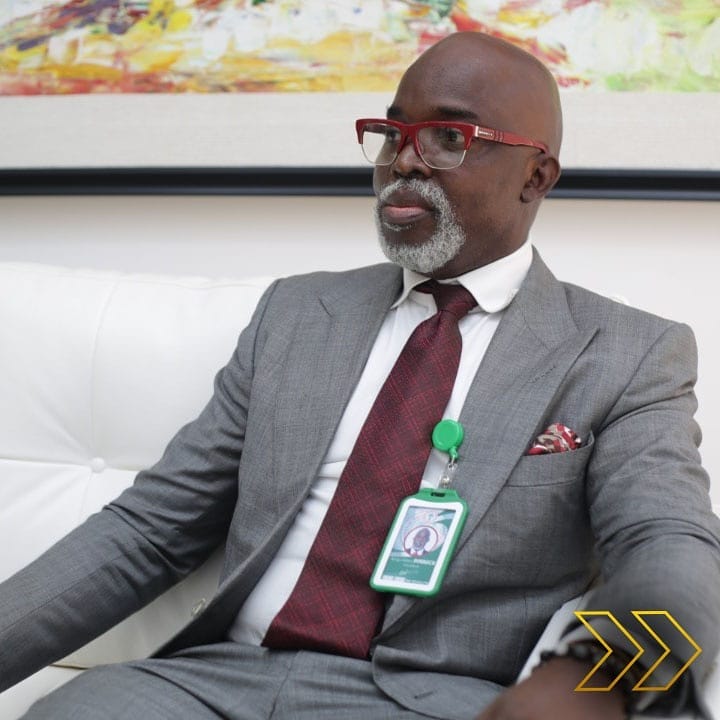
The disappointing outing of the Super Falcons at the last WAFCON and Nigeria’s failure to qualify for the 2027 FIFA Women’s World Cup in Brazil, coming after the Super Eagles also failed to qualify for Qatar 2022 and USA 2026, have understandably generated thoughts, criticisms and suggestions from different quarters.
Such discourse is natural and healthy. However, an open letter by one Arabinrin Aderonke to Rt. Hon. Femi Gbajabiamila, Chief of Staff to the President, particularly caught my attention.
The letter which dwelt almost solely on the person of former NFF President, Amaju Melvin Pinnick, OFR, ROI, appeared to be premised on assumptions that the Federal Government was considering dissolving the NFF board, setting up a Normalisation Committee and appointing Pinnick to head it. The National Sports Commission has since roundly denied those claims.
Yet, beyond those assumptions, what was particularly troubling was the attempt to portray Pinnick as the person responsible for virtually all the misfortunes of Nigerian football, whether during or after his tenure, and by implication suggesting that he is unfit to hold any public responsibility.
There is nothing wrong with setting an agenda or expressing an opinion. But it is unfair to import an individual into a picture he did not pose for, simply to strengthen an argument.
The truth is that in national service, people come, serve, make their contributions and move on. That is precisely what Amaju Pinnick has done.
Performance can only be best judged against available resources, the circumstances of the time and the institutional environment that prevailed.
Since leaving the presidency of the NFF, Pinnick has moved on. He has become increasingly involved in CAF and FIFA affairs, where he has secured influential positions and built relationships within the global football community. He is certainly not looking back at running Nigerian football again.
Away from football administration, he has substantial interests in oil and gas, construction, agriculture, hospitality and entertainment, while enjoying a fulfilling family life.
Through the Brownhill Foundation, he has also continued to support and empower thousands of people through scholarships, educational assistance and community development initiatives, and support for institutions in Nigeria and overseas, including the construction of sports facilities at Hussey College, Warri, Government College, Ughelli, and an e-Library at the University of Benin.
He does not need Nigerian football to survive. Others have taken the mantle of leadership, and the responsibility now rests with them to build on what they inherited, correct what needs correcting and reform the areas that require reform.
Indeed, Pinnick would arguably be among the last people who would advocate the unconstitutional or forced dismantling of the leadership of an institution. As democrats, we should expect whatever changes are required in the NFF to follow due process and the constitutional framework governing football administration.
Putting His Tenure in Context
We are entitled to judge Pinnick’s record as NFF President, but that judgment should be informed by history and context, not selective memory.
Before Pinnick assumed office in 2014, Nigeria had already experienced serious football setbacks. The Super Eagles failed to qualify for the 2006 FIFA World Cup and had missed several editions of the Africa Cup of Nations.
Unarguably, there were certainly disappointments during his tenure. The failure to qualify for Qatar 2022 remains one of them, but there were also significant successes.
Under his administration, Nigeria won the Women’s Africa Cup of Nations in 2014, 2016 and 2018; the FIFA U-17 World Cup in Chile in 2015; Olympic bronze in Rio 2016; the Africa U-23 Cup of Nations; the Africa U-20 Cup of Nations; an AFCON bronze medal; CHAN silver; women’s gold at the African Games; men’s bronze at the African Games; and, importantly, qualified for the Russia 2018 FIFA World Cup, with two matches to spare.
These achievements do not put the administration beyond criticism, but neither does the failure to qualify for Qatar 2022 make the entire tenure a failure.
This distinction is important. Pinnick was an administrator, not a player or coach. His responsibility was to provide the structures, resources and environment necessary for the team to compete. The technical execution on the pitch ultimately belonged to the coaches and players.
In the decisive World Cup qualifying matches against Ghana, the necessary administrative provisions were made: players’ entitlements were paid upfront, the team travelled to Ghana by chartered flight and was accommodated in a top hotel in Kumasi.
That Nigeria still failed to qualify after drawing the return leg in Abuja was disappointing, but it is intellectually dishonest to reduce the entire episode to the administrative performance of the NFF President.
The Business of Football Administration
Away from the pitch, Pinnick’s tenure was arguably one of the most financially ambitious periods in the history of the NFF.
His administration pursued private-sector partnerships with the objective of increasing the federation’s capacity to generate funds beyond government subventions.
The NFF’s financial relationship with government, sponsors, and FIFA and CAF grants, as well as its audited accounts, provide the appropriate basis for evaluating that claim.
Importantly, Pinnick himself supported the engagement of PricewaterhouseCoopers for auditing and Financial Derivatives as financial advisers.
Whatever one’s opinion of Pinnick may be, introducing stronger professional financial structures into the administration of the federation was a step in the right direction.
It is also on record that Pinnick waived a substantial portion of his allowances and entitlements as President of the NFF.
All this happened during an exceptionally turbulent period.
The 2014 NFF election generated controversy. There were competing court processes, attempts to interfere with the federation’s administration and repeated allegations of wrongdoing. The prolonged instability did considerable damage to the image and reputation of Nigerian football.
Despite all of this, the administration continued to function and deliver programmes and competitions.
His Influence Beyond Nigeria
At CAF and FIFA level, Pinnick has used his relationships and influence to facilitate the nomination, appointment and participation of several Nigerians in continental and international football administration. The list is public.
Whether one agrees with every appointment or not, it is difficult to argue that Nigeria gains nothing when its citizens occupy influential positions within continental and global football institutions.
That is part of the soft power every serious football nation should cultivate.
Developing the Next Generation
There is also the question of youth development.
While there can be legitimate debate about the choice of coaches and technical policies, Pinnick’s board did appoint former international, Sunday Oliseh, as Super Eagles coach before the subsequent appointments of Gernot Rohr and Augustine Eguavoen. The administration also gave a number of former internationals opportunities within the technical structures of the federation.
More importantly, the NFF/Zenith Bank Future Eagles Championship was established for U-13 and U-15 players, as part of an effort to create a sustainable pathway for young footballers.
The programme exposed young players to organised competition and contributed to the development of talents who subsequently featured in Nigeria’s U-17 teams, including the squads that participated in the 2019 Africa U-17 Cup of Nations and FIFA U-17 World Cup.
Referees, coaches and football administrators were also sent abroad for training and internships.
These are precisely the kinds of developmental initiatives expected from a national football administration.
Pinnick may not have solved every problem, but it is difficult to argue that he did nothing.
The Real Problem Is Bigger Than Pinnick
This is where the national conversation needs to move.
If we genuinely want to understand the problems of Nigerian football, we must look beyond the NFF and beyond personalities.
The domestic league remains one of our biggest structural weaknesses.
A significant majority of clubs are owned by state governments and operate in environments that often lack the commercial incentives, accountability and professional structures required to run sustainable football businesses.
Stadium infrastructure remains inadequate in many parts of the country. Club managements have struggled to exploit revenue streams beyond government funding. Youth development is inconsistent. Coaching education requires sustained investment. Refereeing needs continuous professionalisation.
There is also the long-standing problem of club ownership politics and the absence of a strong commercial ecosystem around the domestic game.
The result is predictable. Our clubs struggle to develop, retain and properly commercialise top-class players. They struggle to compete consistently on the continent. And they struggle to compete for the attention of Nigerian football fans against the enormous marketing, media and commercial power of the foreign leagues they watch every week.
These are not problems that began with Pinnick nor ended with him. They certainly cannot be solved by continually finding one former administrator to blame.
Let Us Diagnose the System
Nigeria needs a comprehensive national re-examination of its football ecosystem.
Yes, we must examine the NFF, but we must also examine the domestic league, club ownership, stadium infrastructure, youth development, school sports, coaching education, refereeing, commercialisation, broadcasting, sponsorship, sports policy, and the relationship between government and football administration.
We need to ask difficult questions about why a country with Nigeria’s enormous football talent cannot consistently translate that talent into sustainable institutional success.
Most importantly, we must stop confusing personality with system.
The problem with Nigerian football is systemic, not sui generis to one man.
Amaju Pinnick has had his time, possibly made mistakes, as every administrator does, but he also achieved things that should not be erased simply because some people dislike him or disagree with his politics.
He has moved on, and we must learn to let Pinnick be.
Instead of continually dragging yesterday’s administrator into today’s problems, let us have the courage to diagnose the real weaknesses in Nigerian football and fix them.
That would serve the game far better than another round of personalised blame.
Fred Edoreh was Chairman of the Sports Writers Association of Nigeria, Lagos Chapter, and member of the Association of International Sporting Press, AIPS